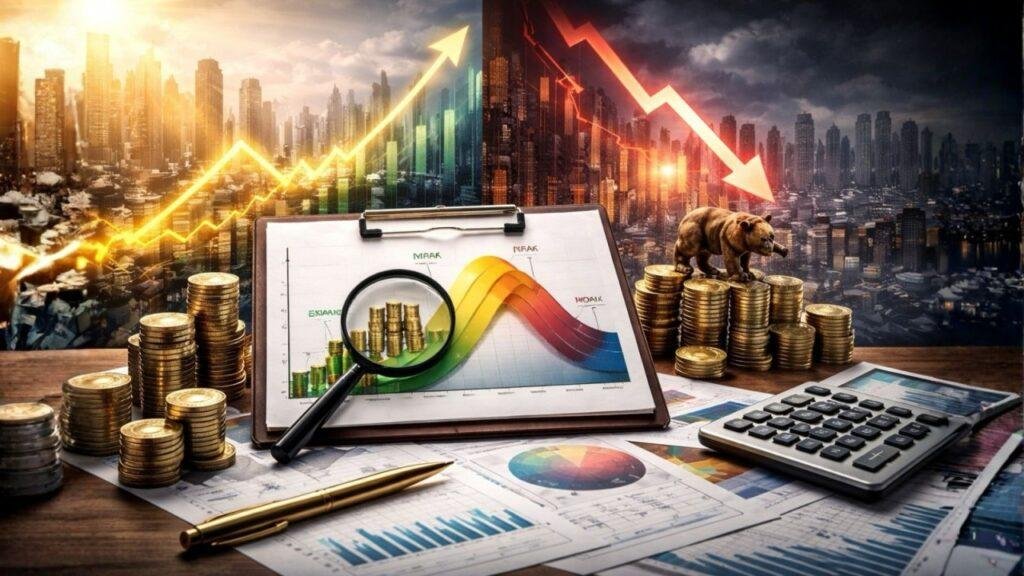
Expansion, peak, contraction and recovery… the pattern repeats, though never in exactly the same way. The economic, or business, cycle reflects the recurring shifts in growth, inflation, profits and market sentiment that shape investment outcomes over time.
While the visual of a wave rising and falling is simple, what happens beneath the surface is far more complex. For investors, understanding these phases is less about perfectly timing the market and more about managing risk and expectations across changing conditions.
Expansion: Growth Builds Momentum
An expansion begins after the economy has bottomed out. Activity starts improving gradually, supported by accommodative policies and improving confidence.
Interest rates are often relatively low, encouraging borrowing by households and businesses. Consumer demand strengthens, companies ramp up production, and hiring picks up. Corporate earnings rise alongside broader economic output, pushing stock markets higher. Gross domestic product trends upward, reinforcing optimism.
Growth-oriented sectors such as technology, financials, communication services and consumer discretionary businesses typically benefit most during this phase, as they are closely tied to rising spending and capital investment.
Peak: When Growth Overheats
At the peak, the economy reaches its maximum pace of growth. Demand begins to stretch supply capacity, creating upward pressure on wages and input costs. Inflation builds as businesses pass higher costs on to consumers.
To prevent overheating, central banks usually begin raising interest rates. Borrowing becomes more expensive, liquidity tightens and profit growth may begin to level off.
Markets can remain strong during this phase, but volatility often increases as investors anticipate a slowdown. Financials may benefit from higher rates, while energy and materials can still perform well as late-cycle demand remains elevated.
Contraction: Slowdown and Recession
Eventually, tighter financial conditions and elevated costs weigh on growth. Consumer spending weakens, particularly on discretionary items. Corporate profits decline, hiring slows and unemployment may rise. Stock markets typically enter a bear phase as expectations reset.
GDP contracts, and in many cases the economy slips into recession. Some downturns are brief and shallow; others are more severe, as witnessed during the Great Depression.
In response, policymakers lower interest rates and may introduce stimulus measures to revive activity. Defensive sectors such as health care, utilities and consumer staples tend to hold up better during this period, as demand for essential goods and services remains relatively stable.
Recovery: The Cycle Turns Again
Recovery begins when economic activity stabilises and starts improving. Policy measures introduced during contraction begin to take effect. Businesses rebuild inventories, hiring gradually resumes and consumer confidence returns.
Financial markets often move ahead of economic data, rising in anticipation of better conditions. Cyclical sectors such as industrials and real estate may outperform early in the recovery phase, positioning for renewed expansion.
From there, the cycle gradually transitions back into a new expansion, and the process begins again.
Why Timing the Cycle Is Difficult
Although the four-phase framework is widely accepted, the duration and intensity of each stage vary significantly. Research from the National Bureau of Economic Research shows that economic contractions have ranged from just a few months to several years.
Because markets are forward-looking, they often turn before official data confirms a shift. By the time a recession is formally declared, asset prices may have already begun recovering.
This makes precise market timing extremely challenging.
Investing Across the Cycle
Rather than attempting to predict exact turning points, investors often focus on gradual portfolio adjustments. Sector rotation strategies, diversification and disciplined rebalancing can help align investments with evolving economic conditions without taking concentrated bets.
The economic cycle should be viewed as a guide, not a guarantee. Staying invested, maintaining diversification and responding thoughtfully to macroeconomic signals generally prove more effective than reacting emotionally to headlines.
In the end, economic waves will keep coming. The goal is not to outrun them, but to build a portfolio resilient enough to ride through both boom and bust.