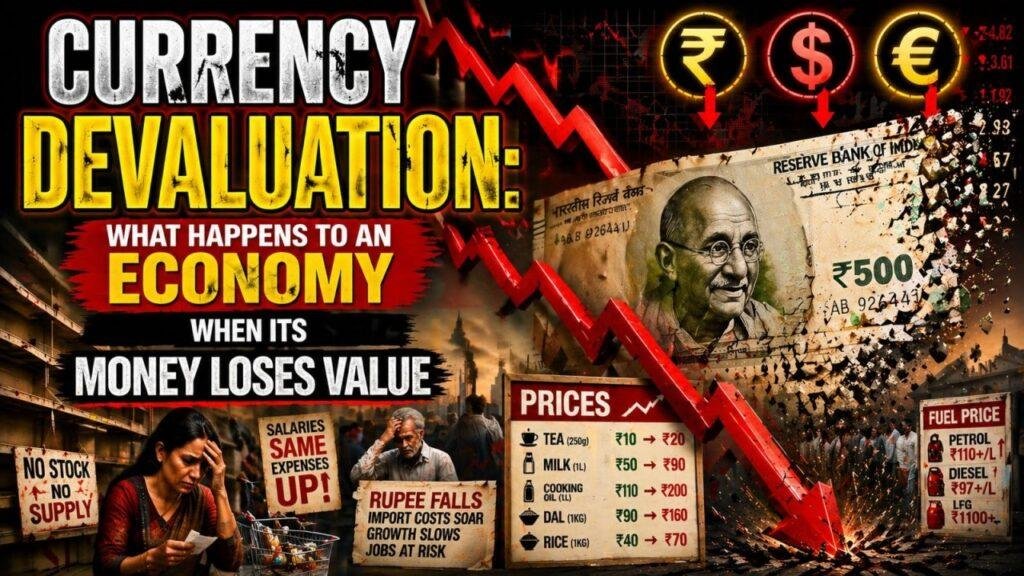
Every few years, somewhere in the world, a currency collapses. The news covers it briefly. People outside the country move on. But for the citizens living through it, the effects are immediate, physical, and deeply disruptive. Prices rise overnight. Savings lose their purchasing power. The cost of imported goods, which in most economies means everything from fuel to medicine to electronics, climbs faster than wages can follow.
Currency devaluation is not always a crisis. Sometimes it is a deliberate policy choice. Understanding the difference, and what each version does to an economy, is more useful than most people realise.
What Devaluation Actually Means
A currency loses value when it buys less than it used to, either relative to other currencies or relative to goods and services within the same economy. These are two distinct phenomena, though they often arrive together.
External devaluation is measured in exchange rates. If the Indian rupee falls against the US dollar, Indian imports become more expensive because the country is paying more rupees for the same dollar-denominated goods. Internal devaluation, more commonly called inflation, means the currency buys less domestically. Your rupee purchases fewer vegetables, less petrol, less of everything.
The two can feed each other. A weaker exchange rate raises the cost of imports, which pushes domestic prices up, which reduces purchasing power further.
When Governments Choose It
Not every devaluation is a disaster. Governments sometimes engineer a weaker currency deliberately, and the logic is straightforward. A cheaper currency makes exports more competitive. If the rupee weakens against the dollar, Indian goods become relatively cheaper for American buyers. Exporters benefit. Manufacturing gets a tailwind. Employment in export-oriented industries can rise.
China’s management of the yuan over several decades is the most studied example of this strategy. By keeping its currency deliberately undervalued, China made its manufacturing sector extraordinarily competitive globally, attracting investment and building industrial capacity at a scale the world had not seen before.
India has used exchange rate flexibility similarly at various points, allowing the rupee to weaken when export competitiveness needed support.
When It Spirals
The controlled version and the crisis version of devaluation can look similar at the start and diverge dramatically from there.
The crisis version typically begins with a loss of confidence. Investors, domestic or foreign, start moving money out of the country. Demand for the local currency falls. The exchange rate drops. If the central bank does not have sufficient foreign reserves to defend the currency, the slide accelerates. Each fall in the exchange rate makes imports more expensive, which raises inflation, which erodes real wages, which reduces consumer spending, which slows growth.
The 1991 Indian balance of payments crisis followed roughly this path. Foreign exchange reserves fell to a point where India could barely cover three weeks of imports. The rupee was devalued significantly. The episode was painful but also became the forcing function for the economic reforms that followed.
More extreme examples carry more extreme consequences. Zimbabwe’s hyperinflation in the late 2000s rendered its currency so worthless that the country eventually abandoned it entirely. Argentina has experienced repeated currency crises over decades, each one eroding middle-class savings and economic confidence in ways that compound over generations.
What It Does to Ordinary People
The effects of devaluation are not evenly distributed, and that is what makes it politically charged.
Exporters and their employees benefit when a weaker currency makes their products more competitive abroad. Borrowers with loans in local currency are relatively insulated. But importers suffer. Businesses that rely on foreign inputs, which in a country like India includes a significant share of manufacturing, face higher costs that they either absorb or pass on to consumers.
Ordinary households feel it most directly at the pump and at the grocery store. Fuel, which India imports heavily, becomes more expensive when the rupee weakens. That cost flows through the entire economy because transportation underpins the price of almost everything else.
People with savings in fixed deposits or cash lose purchasing power quietly, without any single dramatic moment to point to. The number in their account stays the same. What it buys does not.
The Policy Tightrope
Central banks and governments walk a difficult line. A currency that is too strong can hurt exports and slow growth. A currency that is too weak raises inflation and erodes living standards. Neither extreme is sustainable for long.
The Reserve Bank of India manages this balance constantly, intervening in foreign exchange markets to smooth volatility without fixing the rupee at an artificial level. The goal is not a specific exchange rate but a stable, predictable one, where businesses can plan and households can trust that the value of their money will not shift dramatically overnight.
That trust, once lost, is slow to rebuild. The economies that have suffered the worst devaluations share a common thread: not just the loss of currency value, but the loss of confidence in institutions to manage it. That is the real cost. Not just what your money buys today, but what you believe it will buy tomorrow.